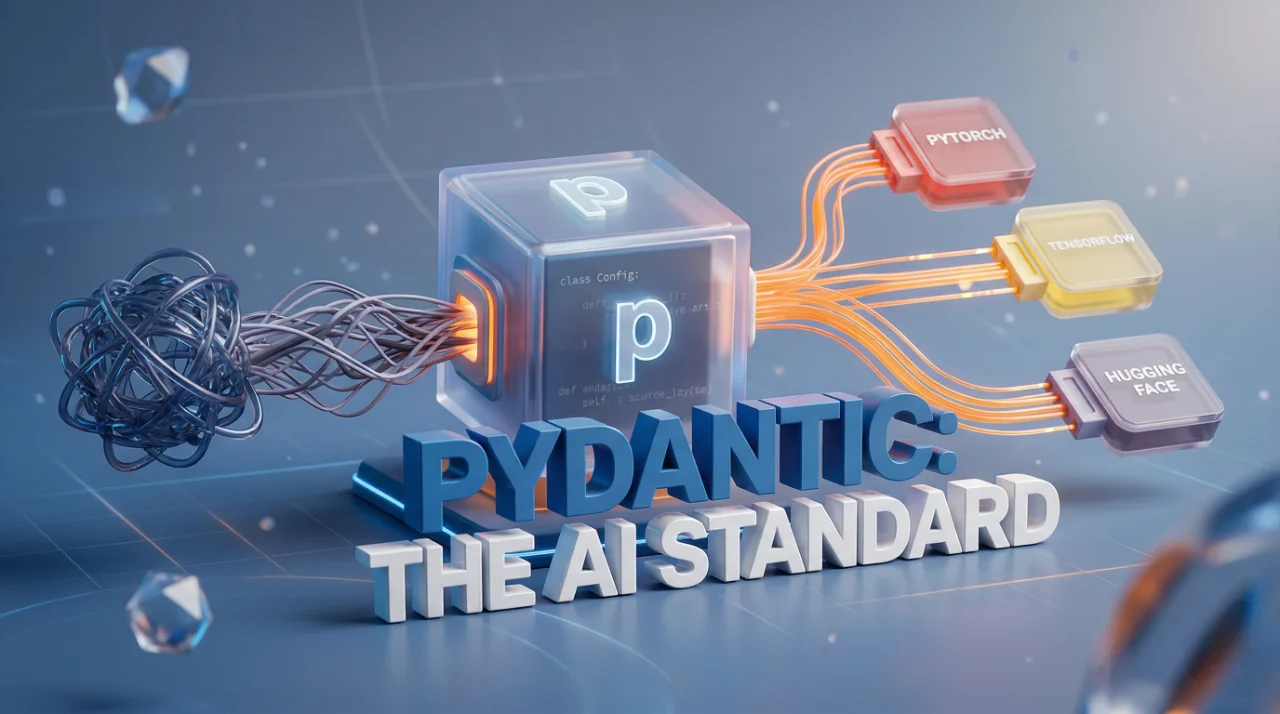
Honestly I didn't even realize how deep Pydantic had gotten into everything until I tried building a project without it. Like, I was setting up a small agent workflow — nothing fancy, just some structured outputs from Claude — and every single library I reached for had Pydantic as a dependency. LangChain? Pydantic. CrewAI? Pydantic. FastAPI? Pydantic. The instructor library? Also Pydantic. At some point you stop calling it a dependency and start calling it infrastructure.
And that's kind of the point. Pydantic started as a data validation library. You define a model with type hints, you throw messy data at it, it either validates or screams at you. Simple. But somewhere between 2018 and now, it became the backbone of basically every serious AI framework in Python. The reason is not complicated — AI apps need structured data, and Pydantic is really good at enforcing structure on chaos.
The part nobody talks about
Here is what I think happened. When OpenAI released function calling, and then every other provider followed, the whole industry suddenly needed a clean way to define schemas, validate JSON outputs from LLMs, and handle the inevitable garbage that models sometimes return. Pydantic was already sitting right there. It had the type system. It had the validation. It had the JSON schema generation built in. So framework authors just... used it. All of them.
I remember at OZ we were building a document extraction pipeline, and the LLM would sometimes return fields with wrong types — like a string where we expected an integer, or a null where we needed a list. Before Pydantic, we had these ugly try-except blocks everywhere. After switching to Pydantic models for our output schemas, validation errors became actually readable. You knew exactly which field broke and why. That alone saved us hours of debugging every week.

Now they have gone way beyond just validation. Pydantic the company — founded by Samuel Colvin — has built an entire stack. Pydantic AI is their agent framework with graph support and MCP integration. Pydantic Evals handles evaluation. Logfire does observability. They even have an AI Gateway for LLM routing and cost tracking. The enterprise list is wild — JPMorgan Chase, Microsoft, NVIDIA, Meta, Cisco, Walmart. MindsDB literally migrated from LangChain to Pydantic AI. That tells you something.